
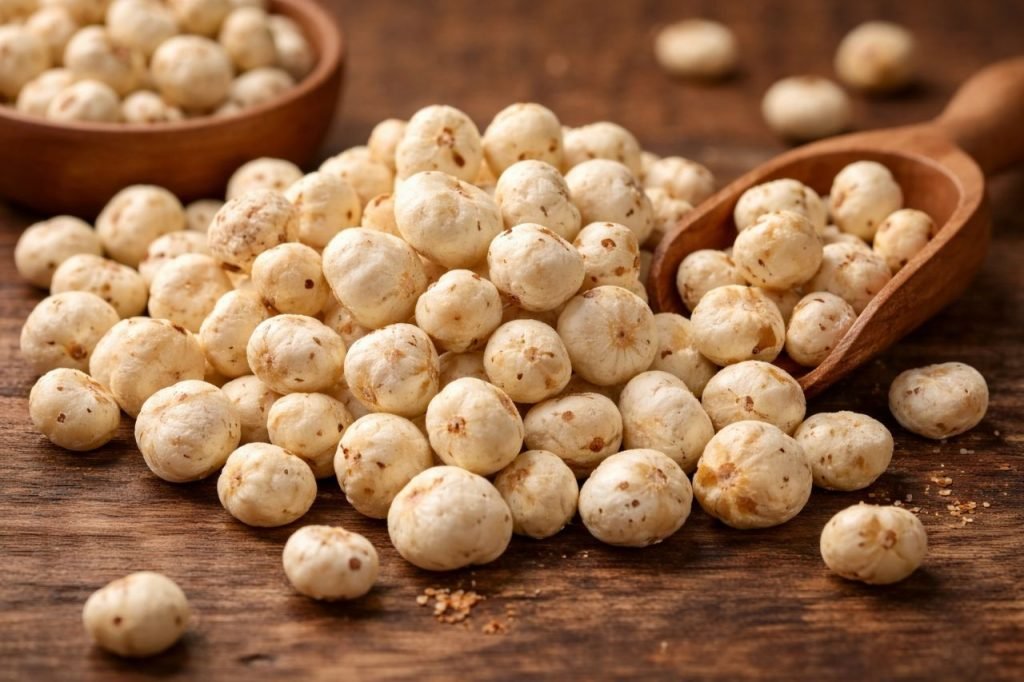
If i say Makhana is miracle food that’s going to change your life overnight, you will not digest my words but it’s actually a pretty solid snacking option if you use it right. These little puffed seeds have been around forever in Indian cuisine and they’re worldwide, almost in all health food stores to office desk drawers.
Here are the top 5 reasons for this –
1. Low Calorie Snacking That Fills You Up
What you’re getting with makhana is about 347 calories per 100 grams, sounds like a lot until you realize how light these things are. The fat content is incredibly low at around 0.1 to 1 gram per 100 grams. You’re looking at 9 to 10 grams of protein in that same amount. Carbs are about 76 grams per 100 grams.
The real magic here is fiber content, somewhere around 14 to 15 grams per 100 grams.
This much fiber creates a feeling of fullness that lasts a few hours. People roast makhana at home with just salt, pepper & turmeric. Office workers keep small containers at their desks because it doesn’t go bad quickly and easy to eat anytime.
It’s way-way better than reaching for chips at 4 PM when you’re starving.
2. Helps Manage Blood Sugar Levels
The glycemic index of makhana is pretty low. We’re talking somewhere between 20 and 35 depending on how you prepare it. Contains resistant starch which slows down glucose absorption in our bodies.
There was a study in the Journal of Food Science and Technology back in 2014 that found fox nut starch showed hypoglycemic effects in animal models. A diabetic person on Quora mentioned eating 30 to 40 grams of plain roasted makhana as a brunch snack and noticed blood sugar spikes were less compared to eating biscuits or crackers.
Caution –
If you’re loading it up with oil, butter or sugar while roasting, you’re probably negating those benefits. Portion control still matters because the fiber and carb content means eating too much can still affect your blood sugar. Their low GI doesn’t give a free pass, which means you cant eat unlimited amounts.
3. Good for Your Heart
Magnesium contents are 210 mg per 100 grams. The potassium content is even better at approximately 1,400 milligrams per 100 grams. Sodium content is incredibly low at less than 1 milligram per 100 grams when it’s plain.
It also has kaempferol, which is a flavonoid that’s been studied for anti-inflammatory effects. That magnesium-potassium ratio supports blood pressure regulation according to studies.
Research in the Asian Pacific Journal of Tropical Medicine identified several alkaloids in Euryale ferox with potential cardiovascular benefits. The downside is that most store bought roasted makhana adds 200 to 400 milligrams of sodium per serving that eliminates the low sodium benefit completely. Homemade preparation is significantly different nutritionally.
4. Packed with Antioxidants
You will find gallic acid, chlorogenic acid and epicatechin in makhana. Research published in Food Chemistry measured total phenolic content at approximately 400 to 500 milligrams per 100 grams in raw seeds.
People think eating makhana will give them anti-aging skin benefits. While antioxidants are definitely present, you’d need to eat way more than most people actually consume to see visible effects. A normal person snack portion is 20 to 30 grams, not 100 grams daily. Above all their availability matters the most.
5. Stimulate Digestive System
The fiber content aids bowel movement in a real way. Contains resistant starch which acts as a prebiotic. Traditional Ayurvedic medicine has used it for digestive issues, though clinical trials are limited on this front.
Someone on the HealthyFood subreddit mentioned switching from popcorn to makhana for late night snacking. They noticed less bloating and more regular bowel movements after 2 to 3 weeks. Another user reported feeling constipated when eating large quantities without adequate water intake.
This gets important because the high fiber without sufficient hydration can actually cause constipation rather than relieve it. You need to drink water when you’re consuming makhana as a snack. This one thing you cant miss.
Is Makhana a Good Source of Protein for Vegetarians ?
Makhana contains all nine essential amino acids. The protein quality is moderate because the biological value is lower than animal proteins or soy. Makhana is marketed as high protein, 30 grams of makhana only gives you 3 grams of protein. You’d need to eat about 165 grams to get 15 grams of protein, which also means consuming 570 plus calories alongside protein.
Alternative Source –
Not practical as a primary protein source. The same 30 gram serving of almonds gives you 6 grams of protein and 170 calories. Roasted chickpeas give you 5 grams of protein and 120 calories. Better to view makhana as a supplementary protein source rather than a main one.
So is Makhana a Good Choice ?
Makhana is expensive compared to other snacks. You’re paying 400 to 800 rupees per kilogram in India or $15 to 25 per pound internationally. Quality varies significantly and cheaper versions are often stale or improperly dried.The texture can be squeaky, almost styrofoam-like when it’s plain. Gets stuck in teeth pretty easily. Some people find that annoying. But it stays crunchy longer than popcorn and doesn’t make fingers greasy. It’s long life validity for months suit travels well. Actually a huge benefit if you’re someone who meal preps or packs snacks for work and the crunch is satisfying in a way that makes you feel like you’re eating something for real.
The idea that makhana is a superfood is overselling it. Most benefits like fiber, minerals and antioxidants are available in many other plant foods often at lower cost. It’s a nutritious option but not irreplaceable. So make your choice wisely.